




.png?width=432&height=358&name=Government%20(1).png)



















E-signatures in Germany: when SES, AdES or QES is enough
In Germany, an electronic signature is valid for most contracts, whatever its level. The law does not prescribe a form for most transactions. The level decides how well you can prove a signature in a dispute, and whether it meets a statutory written-form requirement (Schriftform).
The EU eIDAS Regulation distinguishes simple electronic signatures (SES), advanced electronic signatures (AdES) and qualified electronic signatures (QES). Only the QES replaces a handwritten signature. For a few declarations, German law rules out even the QES. This article shows which level fits which document, what German courts have decided and which rules change before 2027.
Most contracts require no particular form
Purchase agreements, service contracts, orders or non-disclosure agreements between companies can be concluded without any form. An email or a click is legally enough. An electronic signature serves as proof of who signed what and when.
Art. 25(1) of the eIDAS Regulation makes clear that an electronic signature may not be denied legal effect solely because it is electronic or not qualified. Whether a form is required, however, is still a matter of national law (Art. 2(3) eIDAS).
Many German companies have not adopted electronic signatures yet. In the Bitkom Digital Office Index 2024, 32 percent of companies with 20 or more employees said they use digital signature solutions, and another 14 percent were planning to (survey of 1,103 companies, April to June 2024).
The three levels differ mainly in evidential value
A simple electronic signature (SES) covers any data attached to a document that someone uses to sign (Art. 3(10) eIDAS). A scanned signature, initials under an email or a click on a signature field all count. If the signer disputes it, the recipient has to prove it, and the court weighs the evidence freely (Section 286 of the German Code of Civil Procedure, ZPO).
An advanced electronic signature (AdES) must be uniquely linked to the signer and identify them (Art. 26 eIDAS). It is created with data under the signer's sole control and makes any later change to the document detectable. In practice this usually means a login with a second factor and a sealed document with an audit trail. Its evidential value is much higher, but courts still assess it freely.
A qualified electronic signature (QES) is an AdES based on a qualified certificate and created with a qualified signature creation device (Art. 3(12) eIDAS). The certificate is issued by a qualified trust service provider after it has verified the person's identity, for example by video with an ID document. A QES has the same legal effect as a handwritten signature (Art. 25(2) eIDAS). In German courts it carries a presumption of authenticity that only serious doubts can rebut (Section 371a ZPO).
Where German law requires written form, only a QES will do
Where a statute requires written form, the document must be signed by hand (Section 126 of the German Civil Code, BGB). Electronic form can replace it unless the law says otherwise. The issuer then adds their name and signs the document with a QES (Section 126a BGB). For a contract, each party signs an identical document with their own QES.
Today this applies, for example, to fixed-term employment contracts (Section 14(4) of the Part-Time and Fixed-Term Employment Act, TzBfG). The fixed-term agreement must be signed by both sides before work starts. Since 2025, employment references may be issued in electronic form if the employee consents (Section 109(3) of the Trade Regulation Act, GewO). An AdES is not enough in these cases, however secure it is technically.
For consumer credit, the rule changes on 20 November 2026. From then on, text form is enough for general consumer credit agreements, while consumer credit secured on real estate still requires written form (Section 492(1) BGB as amended by the act implementing the Consumer Credit Directive, BGBl. 2026 I No. 139). For agreements concluded up to 19 November 2026, written form applies to both.
Things are different when the parties agree on a form themselves. For a contractually agreed electronic form, a simpler signature is generally sufficient (Section 127(3) BGB).
German courts check the form closely
A judgment of the Berlin-Brandenburg Regional Labour Court of 16 March 2022 (23 Sa 1133/21) shows what a form error leads to. A staffing agency had put a scanned signature of its managing director on fixed-term contracts. The court found this was neither a handwritten signature nor a QES. The fixed term was void, so the employment was deemed to be for an indefinite period (Section 16 TzBfG), even though it was only meant to last a few days (press release of the Berlin labour courts, in German).
The Gera Labour Court decided the opposite case on 7 March 2024 (2 Ca 936/23). A fixed-term agreement that both sides had signed with a QES on a signature platform met the written-form requirement. The judgment is from a court of first instance, and no federal court has ruled on the question yet. The prevailing view in German legal literature agrees with the result.
Some declarations still have to be signed on paper
In a few cases, German law expressly excludes electronic form. A QES is then invalid too.
- Termination of employment and termination agreements (Section 623 BGB)
- Guarantees (Bürgschaft, Section 766 BGB)
- Abstract promises and acknowledgements of debt (Sections 780 and 781 BGB)
There is one exception for guarantees, promises and acknowledgements of debt: if the declaration is a commercial transaction for the guarantor or debtor, no form applies at all (Section 350 of the German Commercial Code, HGB).
Where the law requires notarisation, as for the purchase of real estate (Section 311b BGB), no electronic signature replaces the appointment with the notary.
Since 2025, text form has been enough in several cases
Germany's Fourth Bureaucracy Relief Act relaxed several form requirements on 1 January 2025. Text form (Textform) only requires a legible declaration on a durable medium that names the person making it (Section 126b BGB). An email or a PDF already meets it.
- Commercial leases with a term of more than one year (Section 578 BGB)
- Temporary agency work contracts between the agency and the hiring company (Section 12 of the Temporary Agency Work Act, AÜG)
- Written statement of employment terms, if the employer asks for a confirmation of receipt (Section 2 of the Evidence Act, NachwG), with exceptions for certain sectors
- Agreements that end employment when the employee reaches the statutory retirement age (Section 41 of Social Code Book VI, SGB VI)
- Shareholder resolutions of a GmbH by circulation, if all shareholders agree in text form (Section 48(2) of the Limited Liability Companies Act, GmbHG)
For these documents an AdES is a good default. It meets text form and also proves who signed.
More rules change before 2027
HR, legal and finance teams should know three dates. Only the first one is already law.
- 20 November 2026: general consumer credit agreements only need text form. Pre-ticked boxes are not enough to conclude the agreement (new Section 492(1a) BGB).
- 1 January 2027 (planned): on 2 July 2026 the governing coalition decided to abolish the written-form requirement for fixed-term employment on this date (decision paper, item 34, in German). The form that applies afterwards will be set by the act itself. Until it is promulgated, Section 14(4) TzBfG stays as it is.
- 2 January 2027: the German state EUDI wallet is due to launch. According to the German government, the QES in the wallet is planned for the course of 2027. eIDAS requires that private individuals can use it to sign with a QES free of charge. Member states may limit this to non-commercial use (Art. 5a(5)(g) eIDAS).
Which level fits which document
The overview below is a guide for typical business cases, as of October 2026. In each individual case, the rule that applies to the document decides.
| Level | Typical documents |
|---|---|
| SES | internal approvals, order confirmations, acknowledgements of receipt |
| AdES | non-disclosure agreements, service and framework contracts, quotes, commercial leases, shareholder resolutions by circulation, general consumer credit from 20 November 2026 |
| QES | fixed-term employment contracts, consumer credit secured on real estate, electronic employment references, all cases with statutory written form |
| Paper | termination of employment and termination agreements, guarantees, acknowledgements of debt |
A signature must still be verifiable in ten years
German commercial and tax law requires contracts and business letters to be kept for six to ten years, depending on the document (Section 257 HGB, Section 147 of the Fiscal Code, AO). The certificates behind a signature usually expire after a few years. For a signature to remain verifiable later, time stamps and validation data from the moment of signing belong in the document.
For the QES, eIDAS provides a dedicated qualified preservation service (Art. 34 eIDAS). Since the 2024 reform, the regulation also recognises qualified electronic archiving as a trust service (Art. 45j eIDAS).
For documents that a company issues as an organisation, there is the electronic seal. A qualified seal creates a presumption that the data is unchanged and comes from the named organisation (Art. 35(2) eIDAS). It does not replace a person's signature where the law requires written form.
With a QES, the trust service provider matters
Only a qualified trust service provider may issue qualified certificates. Every member state keeps a public trusted list, and the EU brings them together in the eIDAS Dashboard. Providers are audited at least every 24 months (Art. 20 eIDAS).
Before choosing a solution, ask the vendor these questions:
- Which trust service provider issues the QES, and is it on the EU trusted list?
- How do external signers without their own certificate identify themselves?
- Which audit trail do you receive for each signing, and does the signature stay verifiable after the certificate has expired?
- Where are the signed documents stored afterwards, and who has access?
SecureSign brings all levels into one workflow
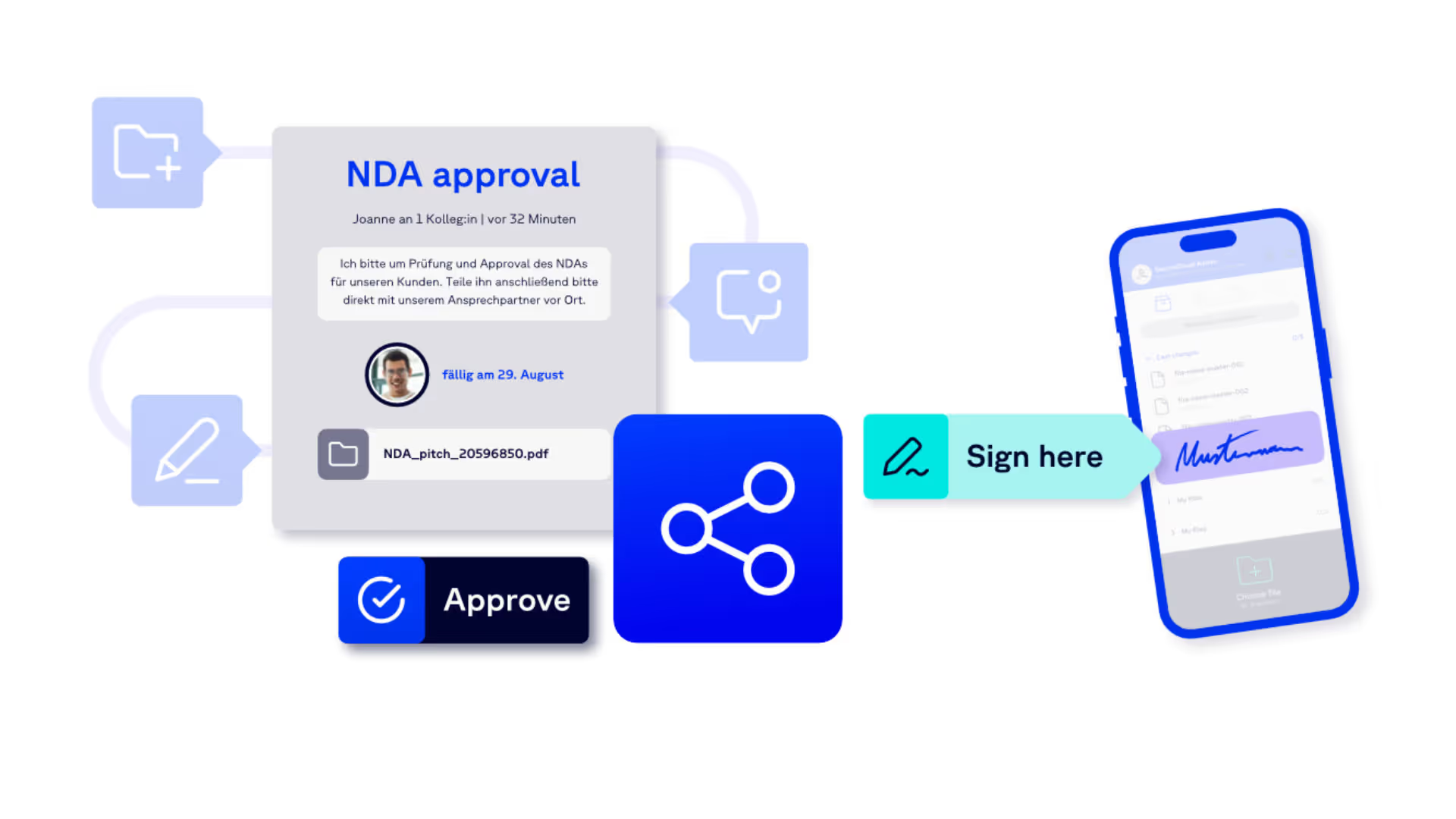
Many companies need several levels day to day, such as an AdES for a quote and a QES for a fixed-term employment contract. SecureSign, the signature module of SecureCloud, covers both in one workflow. The sender decides per document which signature types are offered, from a click through a drawn or biometric signature to a QES.
External signers do not need an account. For a QES they receive a one-time certificate from a qualified trust service provider. People who sign with a QES regularly identify themselves once by video and then sign for three years with a long-term certificate. A login with a second factor can be required for signers, and several documents can be signed together in one signing folder.
SecureSign is a module of SecureCloud GmbH, based in Germany. The qualified certificates are issued by a trust service provider listed on the EU trusted list. More on features and signature types is on the SecureSign page.
The best way to see whether SecureSign fits your processes is to try it in the free trial.
This article gives a general overview and is not legal advice for individual cases. As of October 2026.
Frequently asked questions
Is an electronic signature legally valid in Germany?
Yes. Most contracts require no form, so any electronic signature works. Where the law requires written form, only a QES replaces the handwritten signature.
What is the difference between an advanced and a qualified electronic signature?
Both identify the signer and protect the document against changes. Only the QES is based on a qualified certificate and is equivalent to a handwritten signature.
Which contracts need a qualified electronic signature?
All contracts for which German law requires written form without excluding electronic form, such as a fixed-term employment contract or consumer credit secured on real estate.
Is a scanned signature enough for a fixed-term employment contract?
No. In 2022 the Berlin-Brandenburg Regional Labour Court held a fixed term signed this way void. Both sides need a handwritten signature or a QES.
When is even a QES not enough?
For termination of employment, termination agreements, guarantees and acknowledgements of debt. German law requires paper there. Notarisations stay with the notary.
Can an employment contract be signed electronically in Germany?
A permanent contract needs no form. A fixed term currently requires written form, so both sides need a QES. The coalition plans to change this on 1 January 2027.
What changes for consumer credit?
From 20 November 2026, text form is enough for general consumer credit. Credit secured on real estate still needs written form, which electronically means a QES.
Does a signature with SecureSign meet the written-form requirement?
Yes, if it is signed with a QES and the law does not exclude electronic form. SecureSign provides the QES through a qualified trust service provider.
Interested in the sovereign cloud?
Our experts are happy to tell you more.

Alexander Burba
Alexander Burba is Marketing Manager at SecureCloud and is responsible for brand awareness and positioning online. He follows the German market for secure cloud infrastructure and the regulatory shifts reshaping it, from NIS2 and DORA to the sovereignty requirements now placed on the public sector. In his articles he translates those shifts into the requirements that actually apply in regulated industries, and into the decision that comes next.