




.png?width=432&height=358&name=Government%20(1).png)







.png?width=368&height=447&name=blog-icon%20(1).png)




Turning point in the cloud: Europe overtakes the US in sovereign cloud investments
Gartner predicts: In 2027, Europe will invest more in sovereign cloud infrastructure than North America for the first time. What's behind this - and why it affects every company in Germany.
The figures are clear: Europe will overtake North America in terms of spending on sovereign cloud infrastructure in 2027. This is no longer a pipe dream, but a development that is already clearly picking up speed in 2026. According to a recent study by analyst firm Gartner, European investments in sovereign cloud infrastructure-as-a-service (IaaS) will increase from 6.9 billion dollars in 2025 to 23.1 billion dollars in 2027 - a tripling within two years.
The driving force: geopolitical realities
"Organizations outside the US and China are increasingly investing in sovereign cloud IaaS to achieve digital and technological independence," explains René Büst, Senior Director Analyst at Gartner. The concern is real and concrete: in many places, companies and authorities are evaluating how they can protect themselves against having their access to critical IT infrastructure simply "turned off" from the outside.
This fear is by no means theoretical. When the chief prosecutor of the International Criminal Court (ICC) suddenly lost access to his Microsoft email account in May 2025, it was a wake-up call for many European institutions. Whether direct influence or not, the incident showed the vulnerability of European institutions due to their dependence on US tech providers.
Germany invests billions in its own infrastructure
The reaction was not long in coming. Several lighthouse projects are currently being developed in Germany that give hope for more than just declarations of intent:
Deutsche Telekom & NVIDIA:Industrial AI Cloud
In November 2025, Deutsche Telekom and NVIDIA announced the construction of the "Industrial AI Cloud" in Munich - an investment volume of more than one billion euros. Up to 10,000 GPUs are to be installed there, with computing power equivalent to 2.3 million commercially available computers. The special feature: The data remains entirely in Germany, and the operators are exclusively European employees.
Schwarz Group: 11 billion data center
The Schwarz Group's project (Lidl, Kaufland) is even larger: One of Europe's largest data centers is being built in Lübbenau in the Spreewald at a cost of 11 billion euros. Space for up to 100,000 GPUs is to be created there - ten times more than at Telekom. The digital division Schwarz Digits wants to become the European hyperscaler with its cloud provider StackIT.
These projects are not isolated cases, but part of a European trend. In Germany alone, an estimated 20 billion euros are currently being invested in sovereign cloud and AI infrastructure.
Authorities are getting serious: the exodus has begun
In parallel with infrastructure investments, more and more authorities and public institutions are switching to European alternatives:
International Criminal Court (ICC)
At the end of October 2025, the ICC in The Hague announced the complete switch from Microsoft Office to openDesk - an open source solution developed by the German Center for Digital Sovereignty (ZenDiS). Around 1,800 workstations will be converted.
Schleswig-Holstein: 30,000 workstations
The federal state is currently migrating the entire state administration to Linux and LibreOffice. Over 40,000 email inboxes have already been moved from Microsoft Exchange to Open-Xchange and Thunderbird. Digitalization Minister Dirk Schrödter compares the dependence on US tech giants with Europe's former dependence on Russian gas.
German Armed Forces
In April 2025, the German Armed Forces signed a seven-year contract with ZenDiS for the introduction of openDesk. The Austrian military has also replaced Microsoft Office with LibreOffice.
Federal government: 160,000 licenses
By the end of 2025, 160,000 openDesk licenses are to be rolled out in the German federal administration - a project that is being observed internationally as a blueprint for digital sovereignty.
The figures speak for themselves
The Gartner forecasts show the extent of the shift:
- Worldwide: increase in investment from 59.3 billion dollars (2025) to 110.6 billion dollars (2027)
- Europe: An increase from 6.9 to 23.1 billion dollars - a whopping 235%
- USA: Increase from 12.4 to 15.8 billion dollars - an increase of just 27%
Particularly noteworthy: according to Gartner, around 20% of existing workloads are being moved from global to local cloud providers. The remaining 80% of investments are being made in new digital solutions or the modernization of legacy systems.
The US CLOUD Act as a driver
A key driver for the European turnaround is the US CLOUD Act of 2018, which enables US authorities to compel US companies to hand over data - regardless of where this data is physically stored. Even data in European data centers can thus be made accessible at the behest of the US government.
"Many European organizations fear that they could be cut off from important cloud services for political reasons," explains René Büst from Gartner to TheRegister. This uncertainty is bad for organizations that need to plan for the long term.
Europe takes its sovereignty into its own hands
The European Union is supporting the movement with concrete measures:
EU Cloud Sovereignty Framework (SEAL)
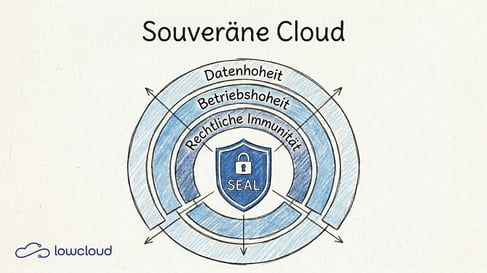
In October 2025, the EU Commission presented its new assessment system: SEAL (Sovereign European Assurance Level). This framework helps authorities and companies to select secure, sovereign cloud services.
180 million euro tender
The EU Commission has launched a six-year tender for sovereign cloud computing services worth 180 million euros. The contract is intended to provide EU institutions, bodies and agencies with European cloud services.
European Digital Infrastructure Consortium (EDIC)
The EDIC was officially founded at the end of October 2025 with the aim of establishing and operating sovereign digital infrastructures.
US hyperscalers under pressure
US hyperscalers are feeling the growing pressure. AWS, Microsoft and Google have each announced "Sovereign Cloud" offerings:
- AWS European Sovereign Cloud
- Oracle EU Sovereign Cloud
- Microsoft Sovereign Cloud
However, Gartner analyst Büst remains sceptical: "Hyperscalers must not treat sovereignty purely as a security, regulation and compliance issue. That would be a mistake - and that's why they will lose market share."
The problem: even with these "sovereign" offerings, the legal dependencies on the US parent companies ultimately remain - be it in terms of software updates, technical control or the corporate structure.
What does this mean for German companies and authorities?
The development towards European cloud solutions is no longer just a trend for public authorities. Regulated industries in particular, such as healthcare, the financial sector and critical infrastructure, are increasingly rethinking and taking action.
The advantages are manifold:
- Legal certainty: GDPR compliance without gray areas
- Business continuity: protection against politically motivated access restrictions
- Competitive advantage: local providers understand European requirements better
- Economic development: Investments stay in Europe
"The strategy today is still cloud-first, but no longer hyperscaler-first," says Gartner analyst Büst, summarizing the new reality.
Conclusion: turning point for Europe
Gartner's forecast is more than just a number. It marks a fundamental shift in Europe's digital strategy. After years of almost complete dependence on US cloud providers, Europe is investing heavily in its own infrastructure and alternatives.
The combination of billions invested in data centers, the switch by major institutions to European solutions and targeted EU policy is creating a credible counterweight to the dominance of US hyperscalers for the first time.
For companies in Germany, this means that sovereign European cloud solutions are no longer a dream of the future, but a reality. The question is no longer whether, but how quickly organizations will take the plunge - and whether they want to be among the pioneers or the laggards.
Do you want to regain your digital sovereignty? SecureCloud offers you a cloud solution developed and operated entirely in Germany - without technical backdoors, without legal US access and with the highest security standards.
Are you interested in the fully sovereign cloud?
Click here for a free trial period

Sebastian Deck
Sebastian Deck is Chief Marketing Officer (CMO) at SecureCloud and is responsible for brand strategy, communications and marketing. He has many years of experience in building and leading international marketing teams in consulting, fintech and technology companies. At SecureCloud, he drives brand positioning, thought leadership and lead generation. He also manages go-to-market initiatives and campaigns to position SecureCloud as a leading provider of cyber security and secure cloud services.