

.png?width=432&height=358&name=Government%20(1).png)











AI Meets Cloud Storage: SecureCloud Launches MCP Server for Seamless AI Integration
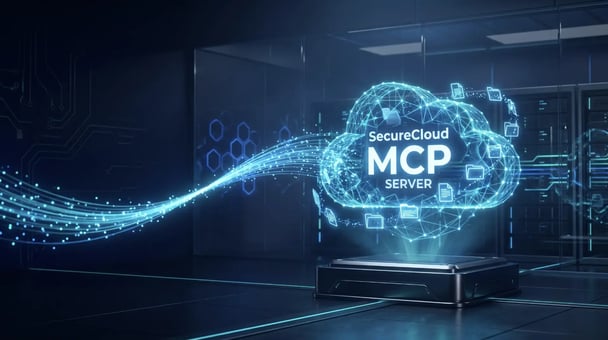
SecureCloud provides an MCP server that connects popular AI assistants directly to your own cloud storage—whether they’re European solutions like Mistral Le Chat and Aleph Alpha or international models. Search for, upload, and manage files—using natural language, without leaving the AI interface. A paradigm shift for productive work with sensitive data.
What’s Behind MCP—and Why It Matters Now
The Model Context Protocol (MCP) is an open standard developed by Anthropic and released in November 2024. The idea: AI models should no longer be confined to an isolated text box, but should be able to securely connect to the systems where companies actually work—file storage, project management tools, and databases.
MCP solves a problem that many companies face in their day-to-day AI work: You use AI assistants for text, analysis, and research—but as soon as your own files are involved, the manual back-and-forth copying begins. Download a document, upload it to the AI, and save the result back again. This not only takes time but also poses security risks when sensitive files pass through unsecured intermediate steps.
This is exactly where the new SecureCloud MCP server comes in.
What the SecureCloud MCP Server Can Do
SecureCloud’s MCP Server connects MCP-compatible AI assistants directly to your SecureCloud storage—whether European models like Mistral Le Chat and Aleph Alpha or international providers like Claude and ChatGPT. Instead of manually uploading and downloading files, the AI works directly with your folders and documents—all via natural language.
Specifically, the MCP Server enables the following actions:
- Manage files and folders —search for, download, upload, rename, move, or delete files. Create new folders or reorganize existing structures. All via voice commands such as: “Move the draft contract from the ‘Drafts’ folder to ‘Final Versions.’”
- Search and organize folder structures – The AI can scan your entire folder structure, search for files, and provide you with an overview of the contents. Instead of clicking through nested directories, simply ask: “Which files were modified in the project folder this week?”
- Control sharing and permissions – Create share links, manage access rights for users and groups, and generate upload links. Example: “Create a password-protected download link for the quarterly figures and set the expiration date to Friday.”
Manage team structures – Create groups, add or remove members, share folders with teams.
A Workday with MCP: From Searching to Finding
To illustrate the impact, here’s a realistic scenario: You’re a project manager at an engineering firm. It’s Monday morning, and you have three tasks to tackle.
Without MCP: You open SecureCloud in your browser, navigate through four folder levels, download a document, open your AI assistant, upload the file, request a summary, copy the result into an email, go back to SecureCloud, and manually create a share link for your colleague. Then you do the same for the next file. Time required: 25–30 minutes.
With MCP: You type into your AI tool: “Summarize the current status report in the ‘Bridge A7’ project folder and create a share link for Thomas.” The AI reads the file directly from SecureCloud, provides the summary, and generates the link. Time required: 2–3 minutes.
This isn’t just a theoretical thought experiment. Studies show that knowledge workers spend an average of 3.6 hours per day searching for and compiling information (https://hbr.org/2012/10/stop-wasting-valuable-time). An MCP server significantly reduces this effort by eliminating the need to switch between systems.
Security: AI Integration Without Loss of Control
The legitimate question with any AI integration is: What happens to my data? Especially in regulated industries—law, tax consulting, healthcare, and public administration—this is not a minor issue, but a core concern.
The SecureCloud MCP server addresses these concerns on several levels:
- Authentication via API tokens – Access is granted via personal API tokens generated in SecureCloud. No password is shared with the AI. The tokens can be revoked at any time.
- Permission model remains intact – The AI sees only what the respective user is authorized to see via the standard interface. Existing sharing settings, group rights, and folder permissions remain unchanged.
- Server location in Germany – Data never leaves the SecureCloud infrastructure in German data centers. The MCP server acts as an interface—the files themselves are not transferred to third parties or permanently stored in the AI model.
- ISO 27001 certified, BSI C5 validated – SecureCloud is certified to ISO 27001 and validated according to the BSI C5 Cloud Computing Compliance Criteria Catalogue. The platform thus meets the security standards required by government agencies, KRITIS operators, and regulated industries in particular for the use of cloud services. These certifications naturally also apply to the MCP interface—it uses the same access path to the same infrastructure.
- GDPR-compliant, Cloud Act-free – Since SecureCloud, as a European provider, is fully subject to the GDPR and is not required to disclose data to U.S. authorities (no Cloud Act, no FISA), digital sovereignty is preserved even when using AI-supported features.
Setup in Just a Few Minutes
Getting the MCP server up and running is intentionally kept simple. Essentially, three steps are required:
First, generate an API token in your SecureCloud profile. Then enter the MCP server URL (https://support.securecloud.de/mcp) into your AI tool—most MCP-compatible assistants offer a setting for this. Finally, confirm the connection, and the AI assistant will have access to your folders.
You can find the complete documentation with step-by-step instructions here.
What This Means for the Future of Cloud Usage
MCP servers are not a niche topic. In addition to the major U.S. providers, European AI companies such as Mistral AI (France) and Aleph Alpha (Germany) are increasingly relying on open interface standards. Gartner predicts that by 2027, over 50 percent of enterprise software will be operated via AI-driven interfaces.
For companies relying on European cloud solutions, this is a strategically important development: Those who obtain AI integration solely from U.S. hyperscalers will become increasingly dependent. The combination of European cloud storage with ISO 27001 certification and BSI C5 certification, along with an open protocol that also works with European AI models, demonstrates that digital sovereignty and AI productivity are not mutually exclusive.
The MCP server is now available to all SecureCloud users—at no extra charge and without any additional modules. Simply activate it and get started.
Interested in the sovereign cloud?
Our experts are happy to tell you more.

Georg Manthei
Georg Manthei is Head of Development at SecureCloud and responsible for the technical advancement of the platform. Since 2023, he has been coordinating new development projects and managing existing ones across the full Software Development Life Cycle. His focus areas include end-to-end automation of IT, development, support and business processes, as well as stakeholder management between engineering and business.