




.png?width=432&height=358&name=Government%20(1).png)





.png?width=368&height=447&name=blog-icon%20(1).png)




Blackout Day and Kill Switch – the risks of digital dependency
The Munich Security Conference has put the spotlight on a very real but often neglected danger: that of a "US blackout day". Specifically, what would actually happen if central US cloud services were no longer available to Europe in the short term - for example due to political pressure, regulatory requirements or as part of a geopolitical escalation?
The answer is as clear as it is worrying: even the failure of individual services would trigger a chain reaction within a few hours, because more and more everyday processes, administrative tools and data flows are concentrated on just a few platform ecosystems.
Cloud dependency as a political risk
In an era of open and ruthless great power politics, IT technologies and supply chains are also transforming into instruments of power with blackmail potential. Digital dependency is no longer an abstract IT issue, but a concrete foreign and security policy risk: those who do not control infrastructure, identities, collaboration or data flows themselves lose their ability to act and sovereignty in case of doubt - with serious consequences for the economy and administration. Another starting point for blackmail.
This danger is not an abstract finger exercise for geopolitical planning games. Numerous independent reports show: US authorities can access data stored by US cloud providers on the basis of the US CLOUD Act - even if this data is stored exclusively in European data centers.
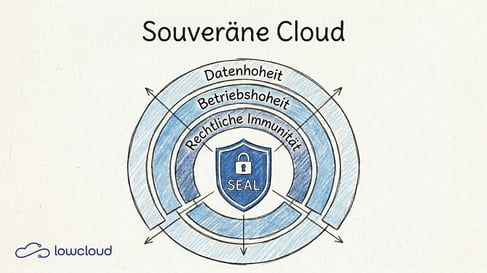
The decisive factor is that it is not just the physical storage location that counts, but the legal jurisdiction of the provider. Microsoft and AWS services that run in Frankfurt or Paris are also subject to US law and are therefore unable to offer European users the "sovereignty" they proclaim for legal reasons.
Why US access rights are strategically relevant
The US CLOUD Act (Clarifying Lawful Overseas Use of Data Act) authorizes US law enforcement authorities to request data from US cloud providers, regardless of where it is stored - and without mandatory judicial review under EU law.
A report by the University of Cologne on behalf of the Federal Ministry of the Interior shows that US authorities can demand access even if data is stored exclusively in European data centers.
Practical examples prove this. Microsoft BitLocker recovery keys in cloud accounts can be stored centrally and US authorities can access them as part of an investigation - which raises considerable governance and risk issues for companies with sensitive data
One sword, two edges: US CLOUD Act and "kill switch risk"
In the current debate on digital dependency, two risks are often confused, although they are structurally different: the CLOUD Act risk and the so-called "kill switch risk". As already described, the US CLOUD Act allows US authorities to demand that US providers hand over data, even if this data is stored in European data centers. This risk therefore primarily concerns confidentiality and data sovereignty.
This must be distinguished from the "kill switch risk". This refers to the possibility that services can be deactivated for technical or regulatory reasons - for example by license servers, central authentication services or export controls. Security analysts have been warning for years that geopolitical tensions or sanctions regimes could lead to technology providers having to restrict their services regionally, as is repeatedly discussed in the case of export controls in the technology sector, for example. The robust stance of the current US administration has made such concerns a much higher priority in the risk assessments of many companies and authorities.
While the CLOUD Act concerns access to data, the kill switch risk concerns the availability and operability of entire systems. Both risks together result in a strategic dependency problem: those who do not control infrastructure, identities, updates and license validation themselves manoeuvre themselves into a structural, self-inflicted external control.
Concrete dangers for German authorities and companies
Numerous experts warn that the GDPR and CLOUDAct are in structural conflict because US law creates so-called "extraterritorial" access optionsthat contradict European data protection law.
However, the problem not only affects commercial data, but also government agencies: Authorities are increasingly using Microsoft or AWS cloud services for critical processes , even though this comes with the risk of US access.
Regardless of the fact that no known access to EU data has yet been made public, Microsoft representatives confirm that it is not technically possible to provide guaranteed protection against access by US authorities - not even for data stored in Europe.
Political and economic dimensions
There are signals from political contexts: at an EU summit on digital sovereignty, German chancellors, European heads of state and experts held intensive discussions on reducing dependencies on US tech giants.
Even outside of political discussions, pressure is growing among companies and authorities to develop exit strategies and alternative architectures, for example by migrating to exclusively European cloud stack providers that are not subject to US jurisdiction.
Why emergency scenarios must not remain an isolated IT case
A single "blackout day" - regardless of whether it is triggered by technical, political or regulatory factors - can become a functional problem for administration, companies and the public within hours because everyday digital processes are highly interlinked and concentrated on just a few providers.
This chain reaction therefore not only affects individual tools, but also
- Access control and identity management
- Communication and team tools
- Backup and disaster recovery
- Contract and signature processes
Such an incident would probably not be a one-off, short-lived "bug" or "outage", but would have the potential to cause a strategic shutdown - with far-reaching consequences for compliance, liability and business continuity.
What companies and authorities need to do now
The relevance of digital sovereignty is not a theoretical debate, but an operational necessity. Three steps show how you can act strategically:
- Risk assessmentand exit strategy: create a documented risk analysis of your cloud dependencies.
- Diversification of systems: Reduce monolithic IT dependencies with modular, sovereign alternatives.
- Audit-proof governance: Use tools that control rights, access and data flows under European law.
You can find a recommendable analysis of the risk of a "blackout day" and possible economic consequences in this episode of Deutschlandfunk Kultur's "Politisches Feuilleton":
Interessiert Sie die souveräne Cloud?
Unsere Experten erklären Ihnen gerne mehr.

Sebastian Deck
Sebastian Deck is Chief Marketing Officer (CMO) at SecureCloud and is responsible for brand strategy, communications and marketing. He has many years of experience in building and leading international marketing teams in consulting, fintech and technology companies. At SecureCloud, he drives brand positioning, thought leadership and lead generation. He also manages go-to-market initiatives and campaigns to position SecureCloud as a leading provider of cyber security and secure cloud services.