























 Alexander Burba
Where an AI tool processes your data is decided by the language model behind it. More precisely, it is decided by the company that operates the model, the data center in which it runs, and the law that operator is subject to. A provider based in Germany can pass your requests to a model in the United States, and a model from an American developer can run in a European data center. If you want to use AI with confidential documents, check every model on its own and decide which model may see which data.
Origin now weighs heavily in the choice. For 87 percent of companies in Germany with 20 or more employees, the country of origin matters when they select an AI provider. 96 percent would prefer AI applications from German providers, while only 41 percent say the same of US providers, down from 51 percent a year earlier (Bitkom, press release of 2 November 2026, 603 companies, in German). Our article on confidential data in AI tools covers the risks when such data ends up in freely available AI tools.
Sovereignty in AI covers more than the server location
The European Commission has defined precisely what "sovereign" means for a digital service in its own procurement. Its Cloud Sovereignty Framework (version 1.2.1, October 2025) assesses cloud services against eight objectives. Alongside law, operations, supply chain and technology, one objective is dedicated to data and AI.
For that objective the Commission looks at three points among others. Storage and processing must be strictly confined to European jurisdictions, with no fallback to third countries. Customers should be able to see when, where and by whom their data is accessed, including when AI models are used. And it counts how far AI models are hosted and governed under European control.
The framework measures sovereignty on a scale from SEAL-0 to SEAL-4. At the first level, EU law applies only formally and can hardly be enforced in practice, because the service and its operations are fully controlled by companies outside the EU. At the second level, EU law is applicable and enforceable, but material dependencies on third countries remain. The highest level requires technology and operations to be fully under European control. In its April 2026 tender, the Commission admitted only providers at SEAL-2 or above.
For choosing an AI model, this means the data center location is one criterion among several. Equally important are who controls the model, which law can be enforced against the operator, and whether you can trace how the model is used.
The model behind the tool decides where data is processed
An AI tool has two parts. The interface in which your team asks questions and uploads documents often comes from a different company than the language model that computes the answer. Many tools pass each request through an interface to a model operator. The text is processed there and, depending on the contract, stored for a period of time.
Every request therefore travels along a chain with three links you should know.
- Operator: which company provides the computing power the model runs on? It can be the developer, a cloud group or a specialised data center operator.
- Location: in which country is the data center that processes the request?
- Law: which legal system applies to the operator and its parent company?
More than the question itself reaches the model. An AI assistant that searches your documents sends the matching passages along with every question, so the model can phrase an answer from them. If someone asks about the notice periods in a framework agreement, the model processes excerpts from that agreement. The more a tool works with company documents, the more the choice of model matters.
The list of subprocessors shows who processes which requests. A model operator that the tool passes your requests to is usually such a subprocessor. Under Art. 28(2) GDPR, the provider may only engage it with your authorisation, and it must impose on it the same data protection obligations it has taken on towards you (Art. 28(4)).
In its guidance on AI and data protection (May 2024, in German), the German Data Protection Conference (DSK) distinguishes closed from open systems. In a closed system, processing takes place in a confined environment, the user keeps control over inputs and outputs, and the data is not used for training. In open systems, inputs leave the protected area and are often transferred to third countries. The DSK considers technically closed systems preferable.
A data center in the EU does not settle every legal question
Many large model providers now offer processing in European data centers. That is progress, because Art. 44 et seq. of the GDPR set additional requirements for transfers to third countries. The server location is only part of the answer, though.
If the operator belongs to a group headquartered in the US, US law applies to it as well. Under the CLOUD Act (18 U.S.C. § 2713), US providers must disclose data in their possession, custody or control when served with a lawful order, regardless of whether the data is stored in the US or abroad.
The GDPR sets its own rule against this. Under Art. 48, a judgment or administrative decision from a third country requiring the disclosure of personal data is only recognised in the EU if it is based on an international agreement in force, such as a mutual legal assistance treaty. A US operator running a European data center can therefore end up caught between two legal systems. How it behaves in that case is not in your hands.
Transfers to the US currently rely on the adequacy decision for the EU-US Data Privacy Framework. The EU General Court upheld it in September 2025 (case T-553/23). An appeal against that judgment is pending before the Court of Justice of the EU (C-703/25 P). How long today's basis will hold is therefore open. The Court of Justice struck down both predecessors, the Safe Harbor decision in 2015 and the Privacy Shield in 2020.
Storage deserves a look too. Some model operators keep requests for a limited time, for example to detect abuse. The exact period is in the contract terms of each model.
Open models can be run by European operators
For many language models, the developer publishes the model weights. Any data center can run such open models itself. A request to an open model at a European operator therefore does not go to the developer, even if the developer is based outside the EU. That brings you much closer to a closed system in the DSK's sense.
Which model fits depends on the task and on the data. For some tasks a company deliberately chooses a large model from a US developer, for confidential documents an open model at a European operator. What matters is that your company makes this choice itself.
Model choice follows the data class
The decision becomes simplest when you sort your data into classes and assign to each class the models allowed to process it. Three classes are enough to start with.
- Public: texts that will be published anyway, such as a draft press release or a job ad. Any model your company has approved in principle can work on these.
- Internal: minutes, project plans and internal guides. Models with processing in the EU, a data processing agreement and a written training exclusion are suitable here.
- Confidential: personnel files, contracts, customer and client data, health data. No group from a third country should be in the chain, and operation should be in the EU or in Germany.
For professionals bound by secrecy, such as law firms, tax advisers and medical practices, § 203 of the German Criminal Code applies as well. We described what that means for using AI in our article on confidential data in AI tools.
Also plan for a data protection impact assessment. Every processing of personal data starts with a risk assessment, and if it shows a likely high risk, an impact assessment under Art. 35 GDPR is mandatory. According to the DSK, this "will often be the case" when AI applications are used. You need the details on operator, location and retention for each model for it anyway.
Seven questions to check an AI model before you use it
Germany's Federal Office for Information Security (BSI) recommends setting fixed criteria for selecting a generative AI model and its operator (Generative AI Models, version 2.0, January 2025, measure M1). They include the guaranteed legal requirements and the options for provision and operation. For use with company data, seven questions follow from this.
- Who operates the model? Ask for the operator of every model on offer, not only the developer.
- Where does it run? Ask for the country or region of the data center, model by model.
- Which law applies to the operator? Check whether a group from a third country is part of the chain.
- Are requests stored? Find out whether and for how long the operator keeps inputs and outputs.
- Is training on your data excluded? Get the exclusion in writing. The DSK advises checking this before any personal data is entered.
- Is there a data processing agreement? If you use an external AI service, you usually need an agreement under Art. 28 GDPR. The model operators should appear on the list of subprocessors.
- Can your IT control the models? Your IT should be able to decide which group may use which models, and to switch individual models off entirely.
Record the answers in a simple table with one row per model. Then link the table to your data classes, so everyone on the team can see which model is approved for public, internal and confidential data.
In SecureCloud kAI, your IT decides which models your team uses
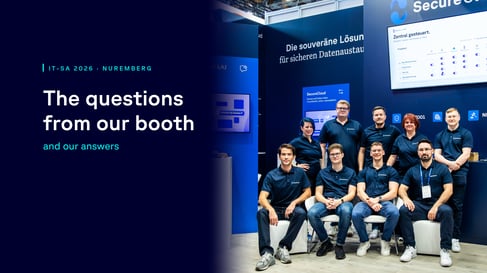
We built this choice into SecureCloud kAI, the AI assistant we presented at it-sa 2026. SecureCloud operates the platform in Germany, and the models run in the EU. When you choose a model, kAI shows where it is operated. We name the operator of every model on our kAI page.
The open models run at European operators, one of them at IONOS in Berlin according to the provider. Requests to these models do not go to the developer. For the models from the two US developers, kAI notes that a US group is part of the chain. Your IT decides per group which models are available and can switch off the US providers' models. That way, the assignment from your data classes maps directly onto your groups.
Read more in our article on the launch of SecureCloud kAI. Would you like to see kAI on one of your own workflows? Then request a demo. Already using SecureCloud? Book your kAI demo directly in our calendar for existing customers.
You can start with question one today. Ask the AI tools your team already uses who operates each model, and ask for their list of subprocessors.
This article gives a general overview and does not replace legal advice on individual cases. As of November 2026.
Frequently asked questions
What is sovereign AI?
Sovereign AI means that a company decides for itself which model processes its data, who operates that model and where it runs. It includes being able to choose models per task and to switch individual models off.
How does the European Commission assess the sovereignty of cloud and AI services?
With the Cloud Sovereignty Framework (October 2025). It checks eight objectives, including data and AI, and places services on a scale from SEAL-0 to SEAL-4. What counts is control, enforceable EU law and dependence on third countries.
Is an AI provider based in Germany enough for data protection?
Not automatically. Many tools pass requests on to a language model from another company. What matters is who operates that model, where it runs and which law applies to the operator.
Can US AI models in European data centers be used in line with the GDPR?
Processing in the EU avoids a transfer to a third country. As part of a US group, however, the operator can be required to disclose data under the CLOUD Act. Also check retention periods, the training exclusion and the data processing agreement.
What is the difference between open and closed AI systems?
According to the German Data Protection Conference, a closed system runs in a confined environment, the user keeps control over inputs and outputs, and the data is not used for training. In open systems, inputs leave the protected area.
Do you need a data protection impact assessment to use AI?
Often, yes. If the risk assessment shows a likely high risk, it is mandatory under Art. 35 GDPR, and according to the German Data Protection Conference that will often be the case for AI applications.
Which questions should you ask an AI provider about its models?
Who operates the model, where does it run, which law applies to the operator, are requests stored, is training excluded, is there a data processing agreement with a list of subprocessors, and can IT enable or switch off models per group?
Which AI assistants show where a model is operated?
SecureCloud kAI shows where each model is operated when you choose a model. SecureCloud operates the platform in Germany, the models run in the EU, and IT decides per group which models are available.
Files, signatures or AI: what does your team need?
In a consultation we work out with you what fits the way your team works: storing and sharing files, signing contracts digitally or using AI with your company data.

Alexander Burba
Alexander Burba is Marketing Manager at SecureCloud and is responsible for brand awareness and positioning online. He follows the German market for secure cloud infrastructure and the regulatory shifts reshaping it, from NIS2 and DORA to the sovereignty requirements now placed on the public sector. In his articles he translates those shifts into the requirements that actually apply in regulated industries, and into the decision that comes next.
Product news and security updates by email